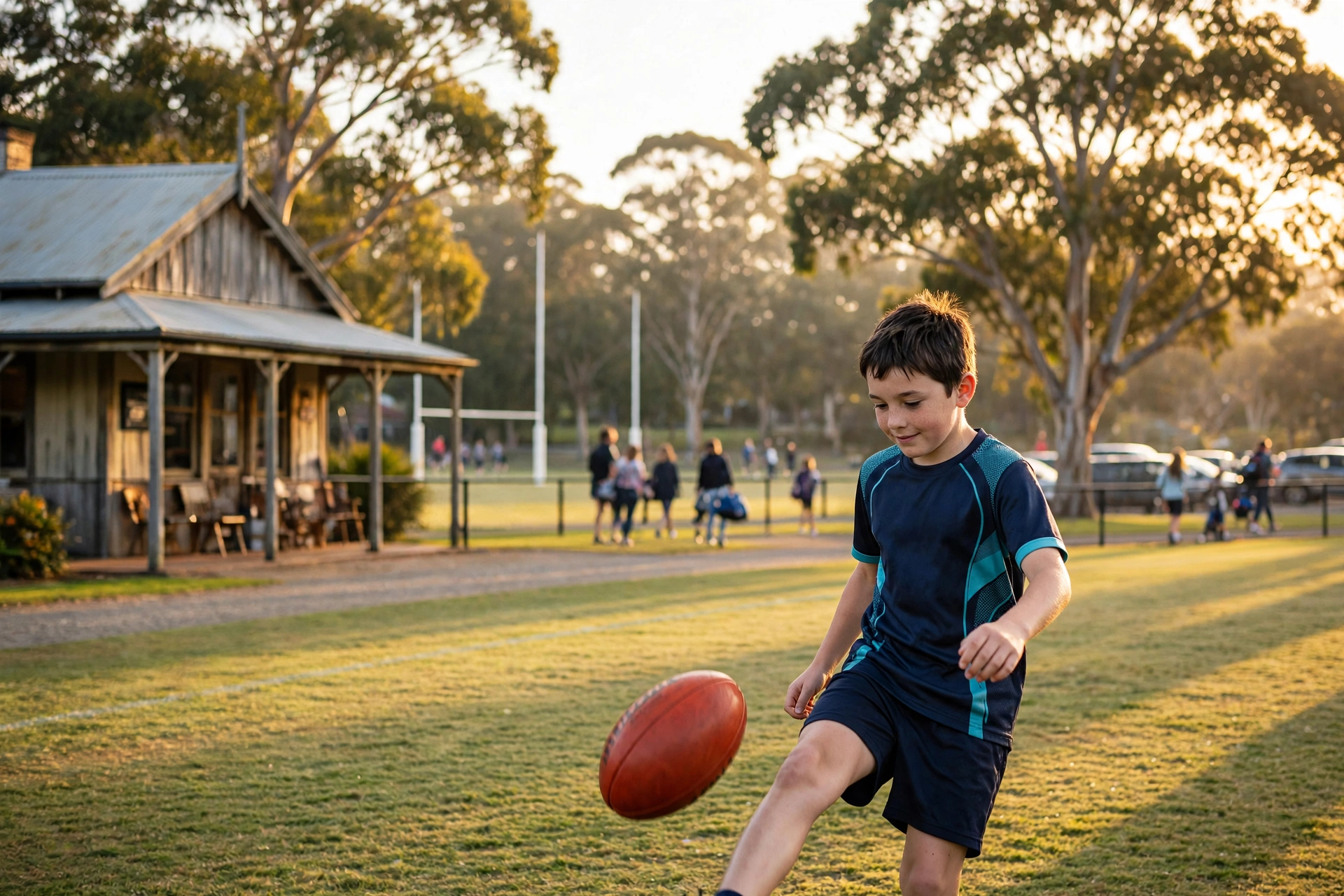
Coaches remember the kid who was warming up before training officially started, more clearly than they remember the kid who kicked the best goal that day. Talent gets noticed in the moment. Habits get noticed over a season.
If you’ve ever asked a coach what actually separates the kids who improve fastest, it’s rarely raw ability. It’s a handful of small, repeatable behaviours that show up week after week, long before the stats do.
Showing up early says more than you’d think
A kid who’s on the field ten minutes before training starts isn’t just being punctual. They’re doing laps, kicking to a mate, getting their body moving before anyone’s blown a whistle. Coaches clock this fast, and not because they’re grading attendance.
It signals something about how the kid feels about being there. There’s a difference between a kid who arrives because a parent dropped them off on time, and a kid who arrives early because they wanted the extra ten minutes. Coaches can tell which one it is within a few weeks.
You don’t need to manufacture this. If your kid is naturally an early arriver, that’s worth naming out loud. “I noticed you were first out there again” lands better than generic praise, because it’s specific and it’s true.
Full effort in the boring drills is the real tell
Anyone can go hard in a match. It’s what a kid does in a repetitive, low-stakes drill. It’s the fifteenth handball in a row, the cone drill nobody’s watching closely that tells a coach how a player actually trains.
Coaches talk about this a lot: the kid who treats a warm-up lap like it’s the last quarter of a final. Not because the drill demands it, but because that’s just how they move. It’s not about being the fastest kid on the track. It’s about not switching off just because the stakes feel low.
This is a genuinely learnable habit, and it’s one of the few things a parent can actually influence without hovering. Kids pick up on whether effort is treated as optional or as the baseline. This mostly comes from what gets noticed and named at home and on the sideline, not from a pep talk before the game.
Leading without being told to
Every junior team has a kid who claps a teammate after a missed shot, or calls out encouragement to the player who’s clearly having a rough quarter, without a coach prompting it. That’s leadership, and it’s got nothing to do with wearing a captain’s armband.
Coaches watch for this specifically because it’s rare and it’s real. A kid can be told to “be a good teammate” a hundred times and it won’t stick the way it does when it’s just who they are on the field. The kids who do this consistently tend to get more responsibility over time. It’s not because a coach decided to fast-track them, but because trust builds the same way habits do: repeatedly, in small moments nobody scripted.
If you want to encourage this in your own kid, the fastest way isn’t a lecture about sportsmanship. It’s pointing out the specific moment you saw it happen. “I saw you check on Jack after he dropped that mark” does more than “be encouraging out there” ever will.
Why these habits matter more than a single good game
A great game is a single data point. A kid who’s early, who trains hard in the boring bits, and who backs up teammates without being asked is showing you a pattern. These patterns are what actually predict whether a kid keeps improving or plateaus.
This is part of why a single stat line from one game can be misleading. A kid can have a quiet game on the scoreboard and still be doing everything right in terms of effort and habits that week. That’s exactly the gap ScorX was built to close. Tracking touches and involvement across a season, not just judging a kid off one bad Saturday, so the pattern is visible instead of guessed at.
How to actually reinforce these habits as a parent
You can’t force a kid to want the extra ten minutes on the field. But you can make it easier for the right things to get noticed and named.
- Name the behaviour, not the outcome. “You worked hard in that drill” beats “great game” — it tells them what to repeat.
- Ask about effort, not just result. “How’d training feel today?” opens a different conversation than “did you win?”
- Don’t wait for the highlight to say something. The car ride home is often about the goal. The habit conversation is better had earlier, closer to when it happened.
- Let the coach be the one who notices leadership. If a coach mentions your kid checked on a teammate, that lands ten times harder coming from them than from you.
Frequently Asked Questions
What habits do coaches notice most in junior players?
Coaches consistently mention early arrival, full effort in low-stakes drills, and unprompted encouragement of teammates as the habits that stand out most — often more than raw skill or a single standout game.
Can these habits actually be taught, or are some kids just like that?
Both. Some kids arrive with a naturally competitive or conscientious streak, but effort and leadership habits are also shaped by what gets noticed and named consistently at home and on the sideline.
Does showing up early actually matter, or is it just a nice-to-have?
It matters because it’s a visible signal of intent. Coaches use it as an early, low-effort way to gauge how a kid feels about being there, well before performance data tells the same story.
How do I encourage my kid to bring more effort to drills without pressuring them?
Praise the specific effort you saw, not the general outcome. “You went hard on that last set” is more effective and less pressuring than “you need to try harder.”
ScorX is free to download for coaches and parents. Track effort and involvement across a whole season, not just the games that make the highlight reel.
Related Sideline Blogs
- 7 AFL Stats That Matter for Junior Development — And 3 That Don’t — Pairs well with this post’s point that a single game rarely tells the full story.
- What Development Coaches Watch at Junior AFL — A closer look at what coaches are actually paying attention to on the sideline.
- 5 Development Goals to Set at the Start of the AFL Season — Useful next step for parents who want to turn these habits into concrete season goals.